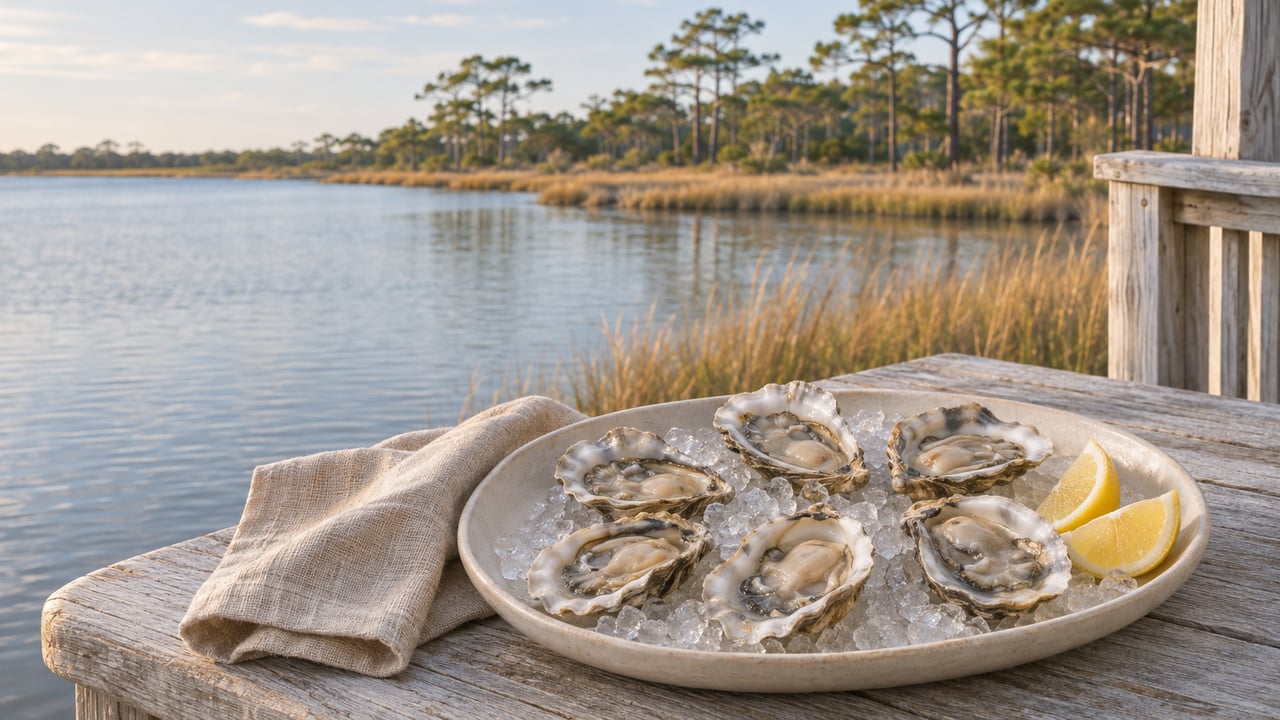
For most of a decade, nobody could legally harvest a wild Apalachicola Bay oyster. Now wild oysters are being tonged again, and the season runs through Feb. 28, 2027. On paper, Indian Lagoon belongs to that bay. The wild harvest, though, is happening on three restored reefs across the water in Franklin County. In the lagoon behind Indian Pass, the oysters coming out of the water this winter are farmed.
The state's harvest status sheet for Nov. 3, 2026, shows the split clearly. Every public bar in Indian Lagoon is marked closed "PER FWC," with a closure date of July 31, 2020. On the same sheet, the aquaculture leases in Indian Lagoon Zone A show as open starting Nov. 1, 2026, for the winter season.
The Bay's Boundary Runs Through the Lagoon
The Florida Fish and Wildlife Conservation Commission defines Apalachicola Bay to include St. George Sound, East Bay, St. Vincent Sound, and "Indian Lagoon and its canals, channels, rivers and creeks." That definition is why the lagoon went quiet when the bay closed in 2020, and it is also why the lagoon falls under the bay's harvest rules now that harvest is open again.
To open a reef to harvest, FWC requires at least 400 bags of legal-size oysters per acre. In October 2025, The Port St. Joe Star reported that Indian Lagoon, which the paper called the westernmost edge of Apalachicola Bay, would stay closed to recreational harvest because it did not meet that threshold. Gulf County commissioners had challenged the closure in state court. The month before that workshop, they voted unanimously to end the case. County Attorney Jeremy Novak told regulators that continuing would require extensive and costly documentation of the lagoon's oyster populations. At the same workshop, Novak asked FWC to hold town halls in Gulf County and to direct part of the bay's restoration money toward it.
The Star also quoted the regulators' own account of why the bay's reefs declined:
"There's not one smoking gun that we can point to as the cause of the decline in oyster reefs in Florida. Rather, it's more like death by 1,000 cuts."
The causes FWC listed included harvest itself, hurricanes, boat wakes, disease, and a shift to a half-shell trade in which shells rarely make it back to the reef they came from.
Three Reefs Carry the Whole Wild Season
FWC's December 2025 announcement said that more than $38 million has been invested since 2019 in restoring the bay's oyster industry. The same release said the restored reefs "are currently the only locations in the bay with oyster abundance that can support harvest." For the Oct. 1, 2026 through Feb. 28, 2027 season, three reefs qualify. The Apalachicola Times reported this allocation for each one:
| Reef | Commercial bags for the 2026–27 season |
|---|---|
| RESTORE Peanut Ridge | 1,029 |
| NFWF Cat Point | 847 |
| RESTORE Cat Point Spur | 557 |
| Commercial total | 2,433 |
The season's total ceiling is 2,560 bags. The 127 bags left over after the commercial total are set aside for recreational harvest. Each recreational permit holder gets one tagged bag, tied to the specific reef printed on the tag. Commercial harvest requires an Apalachicola Bay Endorsement and runs on weekdays only.
The January season gives the numbers a baseline. FWC's reopening ran Jan. 1 through Feb. 28, 2026, the first harvest in the bay since 2020, and about 4,700 commercial bags were available. The Apalachicola Times later reported FWC figures for that season: 153 commercial endorsements at 31 bags apiece, 90% of the commercial allocation harvested, and 4,285 bags harvested in total. The current season is about five months long, roughly two and a half times the length of the January opening, and it has a little over half as many bags.
What 19 Bags Means at the Dock
The Times also worked out what that ceiling means for each harvester. Fewer than 130 harvesters have the endorsement this season, so each can harvest no more than 19 bags between October and the end of February. FWC's commercial page counts a bag as 60 pounds. Barber's Seafood in Eastpoint was paying $65 a bag in early October, so the most any one harvester could gross for the season is about $1,235.
The season also got off to a slow start. Stephanie Barber, whose family owns Barber's Seafood, is one of the few remaining certified processors in Franklin County. She told the Times, "The weather was real nasty so we didn't get in very much stuff. A lot of people are waiting until it cools off before they harvest." She said she expected harvesting to pick up ahead of Thanksgiving, and she thinks eight months of growth since January has likely added volume on the reefs. She also said, "We're excited even if it's 19 bags," and then added, "There's no way they can make a living at it." Wayne Williams, director of the Seafood Work And Watermen's Association, told the paper, "Nineteen bags is nothing." He also said the large rock used in reef restoration is hard to work with tongs.
With wild bags that scarce, local farms grow most of the oysters you'll find on a winter plate around here, and some of that farming happens off Indian Pass Road.
The Lagoon's Winter Clock Started Nov. 1
The Florida Department of Agriculture and Consumer Services publishes a daily open-or-closed table for every shellfish harvesting area from St. Joe Bay to Wakulla County. The Central Gulf status page published Nov. 3, 2026, shows this for the waters around Indian Pass:
- Indian Lagoon, area 1512, spring and fall: public bars closed per FWC since July 31, 2020. Leases closed Oct. 31, 2026, for the seasonal change.
- Indian Lagoon Zone A, area 1542, winter, November through February: public bars closed per FWC. Leases open as of Nov. 1, 2026.
- Indian Lagoon Zone B, area 1552, winter: public bars closed per FWC.
- Indian Lagoon, area 1506: closed year-round.
- St. Joe Bay, area 1401: closed since Aug. 15, 2026, for K. brevis.
That table stays in effect until a status changes. Closures take effect at sunset and reopenings at sunrise. Daily status is also available from the department's Central Gulf field office in Apalachicola at 850-653-8317. The listings describe the state's harvest rules. They are general information and not legal advice, so anyone who plans to harvest should confirm the current rules and status with FWC and FDACS before going out.
One of the farms working those leases is right on the road. Indian Lagoon Oyster Corporation is listed at 2795 Indian Pass Road in a March 2026 Gulf shellfish seed supplier directory from Alabama Cooperative Extension, which identifies it as a nursery that sells oyster seed to other growers. Indian Lagoon Oyster Company describes itself as a family-run farm in Indian Lagoon in Port St. Joe. The FDA's November 2026 Interstate Certified Shellfish Shippers List includes the Port St. Joe business with both a shellstock shipper and an aquaculture designation, with certification running through June 30, 2027.
Without a single public bar open in the lagoon, Indian Pass still has a working oyster operation that ships beyond the county line, and its winter season began on the first of this month.
Reading an Oyster Menu at Indian Pass This Winter
Last winter showed how quickly menus change with the wild season. According to the Tallahassee Democrat, Hole in the Wall in Apalachicola started serving wild Apalachicola oysters on Jan. 2, 2026, and the first delivery arrived to a packed restaurant. Once that season closed at the end of February, the Democrat reported in a March follow-up that area restaurants had gone back to locally farmed oysters or wild oysters from Louisiana and Texas.
So a menu that says "oysters" this winter could mean any of three sources: a bag from Peanut Ridge or Cat Point, a farmed oyster from a nearby lease, or a shipment from farther west along the Gulf. Ask your server where the day's oysters came from.
Indian Pass Raw Bar at 8391 County Road 30A lists raw, baked and steamed oysters on its online menu. Its contact page lists hours of noon to 9 p.m. Tuesday through Sunday, closed Mondays. Holiday weeks can change a schedule, so call ahead before driving out on a weeknight.
The wild season has its own deadline. The open reefs close Feb. 28, 2027, and FWC sets each season's harvest levels based on how many oysters are on the reefs. The Zone A leases in Indian Lagoon follow the November-through-February winter classification on the state's table, so the farmed season and the wild season end in the same month.
The Duarte Team at Eli Duarte has followed the oyster seasons along Indian Pass Road for a long time, and we're glad to talk about this one in English or Spanish. If you own near the lagoon and want to know what your place is worth this winter, ask us for a free home valuation or our local market guide.